— Story structure —
Three-Act Structure
Setup. Confrontation. Resolution.
The oldest structural model in Western storytelling, and the one every other framework argues against. What three-act structure actually requires, where it breaks down, and how to use it without writing something predictable.
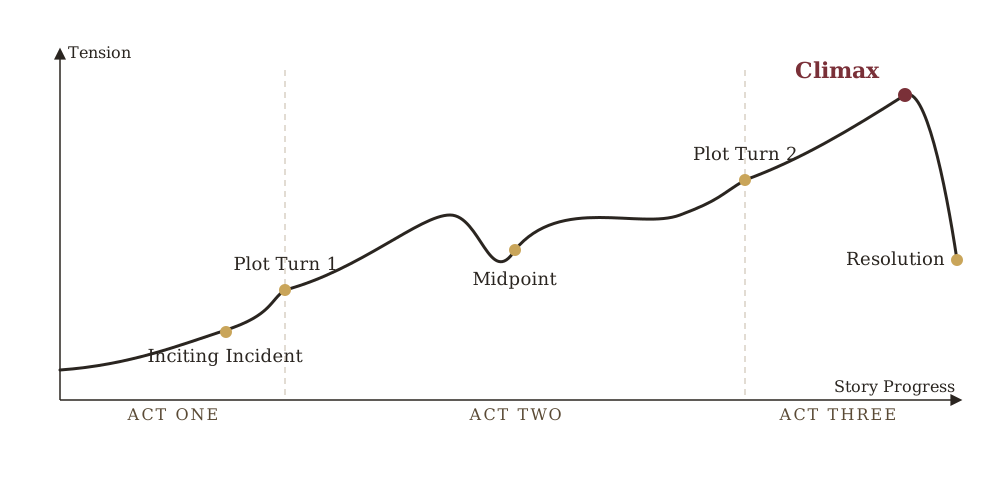
If you have read anything about story structure, you started here. Three-act is the default. It is the framework that writing books explain first and that most other frameworks define themselves against — the Fichtean Curve by skipping act one, the five-act by subdividing act two, the hero’s journey by mythologizing the whole thing.
The reason it keeps coming back is that it describes something real about how audiences experience stories. Not the only real thing, but a persistent one: a story that establishes a world, disrupts it, and resolves the disruption feels complete in a way that other shapes sometimes don’t.
The danger is that “three acts” has become shorthand for a rigid template — inciting incident on page 25, midpoint reversal at the halfway mark, climax at the three-quarter mark. That template exists, and it works for screenplays on a deadline, but it is not what three-act structure actually is.
What it actually is
Three-act structure is a claim about dramatic rhythm: a story needs a beginning that establishes, a middle that complicates, and an end that resolves. That’s it. Aristotle said roughly this in the Poetics. Everything since then — Syd Field’s paradigm, the Save the Cat beat sheet, the Hollywood formula — is a more specific opinion about what happens inside those three movements.
Act One — Setup. The audience meets the protagonist, understands the world, and encounters the disruption that will drive the rest of the story. The act ends when the protagonist commits to dealing with the disruption. In a novel this might be thirty pages or eighty; the length is not the point. The point is that by the end, the reader knows what the story is about.
Act Two — Confrontation. The protagonist pursues the goal established at the end of act one and encounters escalating obstacles. This is the longest act and the hardest to write, because “escalating obstacles” is easy to say and difficult to sustain for two hundred pages without the story sagging in the middle. Most structural advice — midpoint reversals, pinch points, the “fun and games” section — exists to solve the act-two problem.
Act Three — Resolution. The obstacles converge into a climax. The protagonist either succeeds or fails (or succeeds at a cost, or fails in a way that reveals something). The aftermath settles. The story closes.
The act-two problem
Act two is where three-act structure lives or dies, and it is where most manuscripts get into trouble.
The reason is structural. Act one has a built-in engine: the audience is learning about the world, so nearly anything you show them is interesting by default. Act three has a built-in engine too: the story is converging, tension is high, and the reader wants to see how it ends. Act two has neither of those advantages. The world is established. The ending is not yet in sight. You are in the middle, and the middle has to earn its keep through craft rather than structural momentum.
The most common solution is the midpoint reversal: a revelation, failure, or shift roughly halfway through act two that reframes the protagonist’s goal or the terms of the pursuit. Before the midpoint, the protagonist is reacting; after it, they are acting. Or before the midpoint, they think the problem is X; after it, they realize the problem is Y. The midpoint creates a second engine inside the long middle of the story.
Where it works
Three-act structure is a natural fit for stories with a clear protagonist, a defined goal, and escalating external obstacles. That covers a lot of fiction.
Genre fiction with a central quest. Thrillers, mysteries, fantasy novels with a mission, romance with a clear pairing. The goal provides the through-line; the acts organize the complications.
Screenplays. Film is a time-constrained medium, and three-act structure maps cleanly to roughly 30/60/30 minutes. The rigidity that novelists sometimes resist is a feature in screenwriting, where the audience’s attention span is fixed. (For the screenplay-specific refinement, see the sequence method.)
Novels with a strong external plot. If the story is driven by something the protagonist is trying to do — solve a crime, win a war, escape a situation — the three-act scaffold gives the reader a sense of progress. They know where they are in the story because the obstacles tell them.
Where it doesn’t
Character-driven fiction where the goal is internal. If the protagonist’s real journey is emotional or psychological — learning to grieve, coming to terms with a betrayal, growing up — three-act structure can feel like a straitjacket. The story doesn’t have an “inciting incident” because the condition was already there. It doesn’t have a climax because the transformation is gradual. Literary fiction often resists the three-act model for exactly this reason.
Episodic structures. Some novels work as a series of contained episodes rather than one long arc. The Fichtean Curve is better suited to this shape — crisis after crisis with character development built into each one rather than distributed across a three-act arc.
Multi-protagonist stories. Three-act structure assumes one main through-line. With three or four protagonists whose storylines intersect, the act breaks get blurry. Each protagonist might be in a different act at the same time.
Planning in three acts
If you decide three-act structure fits your story, the planning work is straightforward — which is the whole appeal.
Start with the disruption. What changes in the protagonist’s world that forces them to act? That is the end of act one. Now work forward: what do they try, and why does it fail or cost more than expected? Each attempt should be harder than the last. At the midpoint, something shifts — the goal changes, the stakes rise, the antagonist reveals a new dimension. The protagonist’s approach has to change in response.
For act three, the question is convergence. All the threads — the main plot, the subplots, the character work — need to arrive at the same place. If you have a subplot that resolves independently of the climax, it is either in the wrong story or it needs to be woven tighter.
The trap to avoid is mistaking the template for the structure. “Inciting incident at 12%” is a screenplay convention, not a law of narrative. A novel can take three pages or three chapters to establish its world. What matters is that by the time the disruption arrives, the reader cares enough to follow the protagonist into act two.
Three-act and revision
Three-act structure is at least as useful in revision as in planning. Many writers who don’t outline in acts discover, in their second draft, that the manuscript already has an implicit three-act shape. The question is whether it’s a good one.
The revision test is pacing. Map each chapter or scene to the act it belongs in. Is act one doing its job? Does the reader have what they need to care about the disruption? Is act two sagging — same-difficulty obstacles, subplots running in parallel without intersection? Does act three converge or just stop?
This is architectural work. You cannot do it by reading the manuscript straight through. You have to step back and see the shape — the pacing per chapter, the distribution of plot versus character work, the escalation curve across the whole book. A developmental editor does this instinctively. A revision checklist can approximate it. The goal is the same: see the structure clearly enough to fix what isn’t working without dismantling what is.
Not the only option
Three-act is the default, but it is not the only viable structure, and defaulting to it out of habit rather than choice is how predictable novels happen. If your story opens in crisis and stays there, consider the Fichtean Curve. If your story has five clear movements — exposition, rising action, climax, falling action, denouement — the five-act model may describe it better. If the interest is not in a goal but in a journey, the hero’s journey or Kishōtenketsu might be worth studying.
The value of learning three-act structure is not that you should always use it. It’s that understanding the default gives you a framework to push against when your story needs something different.
Last updated April 22, 2026.