— Screenwriting —
Screenplay Structure and the Sequence Method
Eight sequences. Two hours. No room to wander.
How screenplay structure differs from novel structure, why the three-act paradigm is not enough on its own, and how the eight-sequence method gives screenwriters a practical framework for pacing a feature film.
A screenplay is not a short novel. It looks like one on the shelf — a hundred-odd pages, structured in scenes, driven by characters who want things. But the constraints are different in ways that change how structure works.
A novel reader controls the pace. They put the book down, reread a paragraph, skip ahead. A film audience does not. They sit in a dark room and the story moves at exactly the speed the filmmaker chose. If the structure sags for ten minutes, those ten minutes are gone. The audience felt them. There is no skipping ahead.
That constraint — fixed runtime, no reader control — is why screenplay structure is more rigid than novel structure, and why screenwriters have developed frameworks that novelists rarely need.
Three-act, but tighter
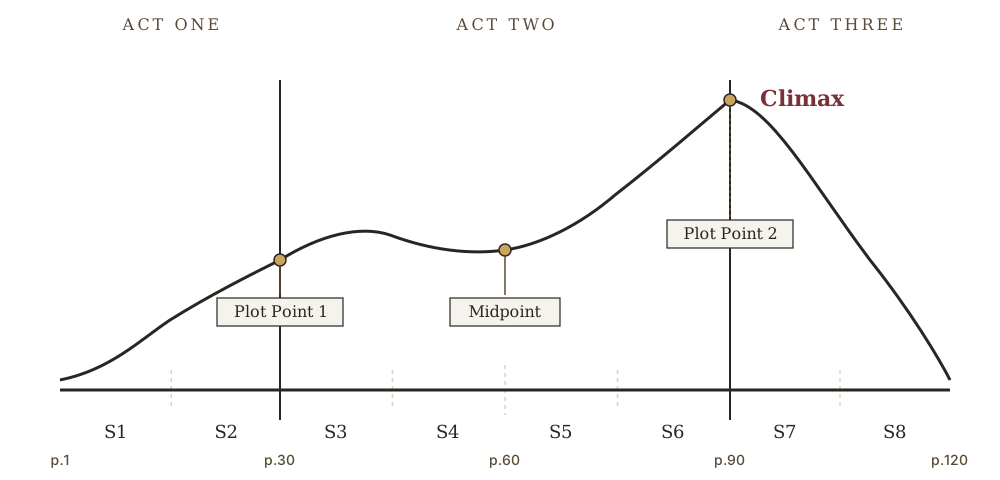
Three-act structure applies to screenplays, but in a more compressed form. Syd Field codified the version most screenwriters learn first: act one runs roughly 30 pages (minutes), act two runs 60, act three runs 30. The inciting incident falls near the end of act one. The midpoint reversal bisects act two. The climax opens act three.
This framework is real and it works, but it leaves a practical problem unsolved: act two is still sixty pages long. Sixty pages of “escalating obstacles” with no further subdivision is where most screenplays fall apart, for the same reason most novels sag in the middle — the middle is too long to sustain on momentum alone.
The sequence method exists to solve that problem.
The eight-sequence method
Frank Daniel, the Czech-born screenwriter and film educator who ran the graduate programs at Columbia and USC, proposed a structural model based on sequences rather than acts. A feature film, he argued, is not three acts but eight sequences, each roughly 10 to 15 minutes long. Each sequence has its own internal arc — a setup, a rising tension, and a resolution that pivots into the next sequence.
The eight sequences map onto three acts, but they carve the long middle into manageable pieces:
Act One (sequences 1–2)
Sequence 1 — Status quo and inciting incident. Establish the protagonist, their world, and the disruption. The sequence ends when the protagonist becomes aware of the central problem, even if they haven’t committed to solving it yet.
Sequence 2 — Debate and commitment. The protagonist resists or considers the problem. By the end of this sequence, they commit to action. This is the act-one turning point — the door that closes behind them.
Act Two (sequences 3–6)
Sequence 3 — First attempts. The protagonist pursues the goal with their initial strategy. Things seem to be working, or at least progressing. The audience learns the rules of the world the protagonist has entered.
Sequence 4 — Complications. The initial strategy stops working. New obstacles appear. The sequence ends with a setback that forces the protagonist to regroup. This is often where the first major subplot complication lands.
Sequence 5 — Midpoint and new approach. Something shifts — new information, a betrayal, a revelation. The protagonist’s understanding of the problem changes. They adopt a new strategy. The midpoint reversal lives here.
Sequence 6 — Mounting pressure. The new approach works better but the stakes are higher. The antagonist responds. Subplots converge on the main line. The sequence ends at the act-two turning point: the lowest moment, the apparent defeat, the crisis that makes the climax inevitable.
Act Three (sequences 7–8)
Sequence 7 — Climax. The protagonist faces the central problem with everything they have learned. The decisive confrontation plays out.
Sequence 8 — Resolution. The aftermath. New equilibrium. The protagonist has changed, or the world has, or both.
Sequences vs. scenes
A sequence is not a scene. A scene is a continuous unit of action in a single location and time. A sequence is a dramatic unit — it contains multiple scenes unified by a single dramatic question.
The distinction matters for planning. When you outline a screenplay scene by scene, you can end up with forty or sixty entries and no clear sense of rhythm. When you outline in sequences, you have eight entries, each with a question that drives it and an answer that turns the story. The scenes inside each sequence serve that sequence’s question.
This is also where the sequence method connects to the Fichtean Curve. Each sequence ending is a small crisis — a resolution that creates new problems. The eight-sequence structure is, in a sense, a Fichtean staircase with exactly eight steps, constrained by the fixed runtime of a feature film.
The beat sheet question
Blake Snyder’s Save the Cat beat sheet is the other framework screenwriters encounter early. It names fifteen beats — Opening Image, Theme Stated, Catalyst, Break into Two, B Story, Midpoint, All Is Lost, Dark Night of the Soul, Break into Three, and so on.
The beat sheet and the sequence method are not competitors. They describe the same shape at different resolutions. The fifteen beats mostly fall at sequence boundaries or midpoints. “Break into Two” is the end of sequence 2. “Midpoint” is the middle of sequence 5. “All Is Lost” is the end of sequence 6.
The practical difference is that the beat sheet tells you what should happen at each point (a thematic statement, a false victory, a whiff of death), while the sequence method tells you how long each structural unit should run and what dramatic question holds it together. Working screenwriters tend to use both — the beat sheet for content, the sequences for pacing.
Where this differs from novel structure
Novelists reading this may notice how much of the framework is driven by time. Ten to fifteen minutes per sequence. Thirty pages for act one. Midpoint at page fifty-five. This precision feels alien if you write novels, where a chapter can be three pages or thirty and nobody checks a stopwatch.
That rigidity is not arbitrary — it comes from the audience’s inability to control pace. A novel with a slow third chapter still works if the reader powers through it in ten minutes. A film with a slow third sequence loses the audience for fifteen minutes in real time, in a dark room, with no way to skim.
The other difference is density. A screenplay is 90 to 120 pages. A novel is 300 to 500. The screenplay cannot afford exposition that doesn’t also advance plot, or character moments that don’t also raise tension. Every scene has to serve the sequence’s dramatic question and develop character and deliver information the audience needs. The dual-purpose discipline of the Fichtean Curve’s crisis test — does this moment advance plot and reveal character? — is not optional in a screenplay. It is the baseline.
Planning a screenplay in sequences
Outline the eight sequences before you write scenes. For each sequence, define:
- The dramatic question. What is the audience wondering during this stretch? The answer to that question is how the sequence ends.
- The pivot. How does this sequence’s resolution create the conditions for the next sequence’s question?
- The character turn. What does the protagonist learn, lose, or decide in this sequence that they didn’t have at the start of it?
If you can write those three lines for each of the eight sequences, you have a structural spine. The scenes fill in from there — each scene serving its sequence’s question, each sequence serving its act’s arc.
Sequences beyond film
The sequence method was designed for feature films, but the underlying principle — subdivide the long middle into units with their own dramatic arcs — works anywhere that pacing matters.
Television uses sequences naturally: each act break (before a commercial) is a sequence boundary. Limited series map almost exactly to the eight-sequence model stretched across six or eight episodes. And novelists dealing with a sagging second act can borrow the same trick — carve the middle into four sequences, give each one a dramatic question, and suddenly the two hundred pages between the inciting incident and the climax have internal structure instead of vague “escalating obstacles.”
The framework is a tool, not a rule. But for screenwriters working in a medium where time is fixed and the audience cannot skim, it is the most practical structural tool available.
Last updated April 22, 2026.