— Craft fundamentals —
Pacing a Manuscript
Pacing is not speed. It is the management of the reader's experience of time.
How to pace a novel at the structural level: chapter length as rhythm, dialogue and prose density as levers, diagnosing the sagging middle, and seeing the shape of a manuscript in revision.
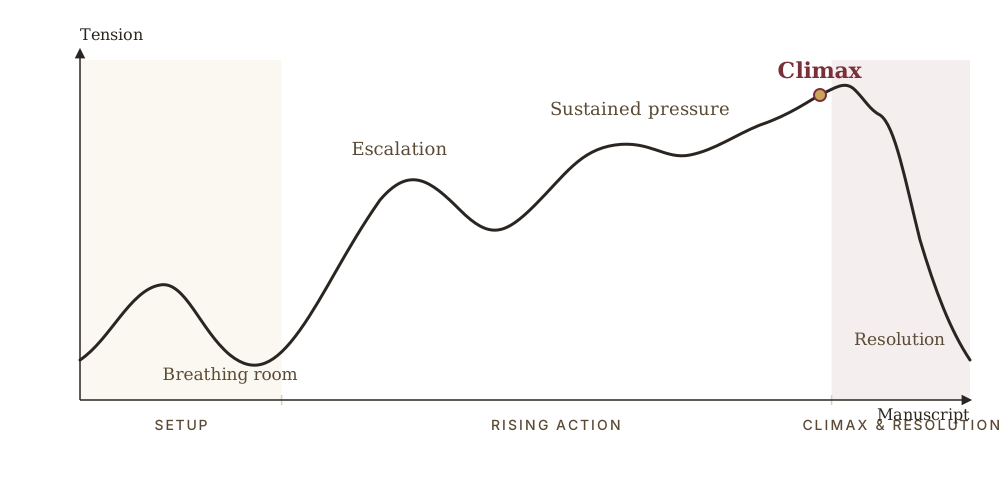
Pacing advice usually arrives at the sentence level. Vary your sentence length. Short sentences create urgency. Long ones slow the reader down. This is true and nearly useless for the kind of pacing problem most manuscripts actually have, which is structural: the book feels fast in the wrong places and slow in the wrong places, and no amount of sentence-level tinkering will fix it because the problem is in the architecture, not the prose.
Structural pacing is about the reader’s experience of time across the whole manuscript – how the ratio of tension to release shifts from chapter to chapter, how the density of the prose changes, how chapter lengths create a physical rhythm that the reader feels even when they are not conscious of it. It is the least discussed and most consequential element of novel construction, because a well-paced manuscript can survive mediocre prose, but a beautifully written manuscript with broken pacing will be abandoned halfway through.
Chapter length as rhythm
A chapter is a unit of attention. When a reader finishes a chapter, they make a micro-decision: keep reading or stop. Short chapters lower the barrier. “Just one more” is easier to justify when the chapter is eight pages than when it is thirty. This is not a trick; it is a fact about how readers manage their time.
But it is not an argument for short chapters everywhere. A novel written entirely in four-page chapters has a staccato rhythm that becomes monotonous. The reader adjusts to the pace and stops feeling it. What creates the sensation of pacing – the feeling that the story is moving – is variation.
James Patterson writes almost exclusively in short chapters. It works for his genre because the content demands it: fast plot, minimal interiority, constant forward motion. Donna Tartt writes long chapters because the content demands the opposite: immersion, accumulation, the slow accretion of detail that builds a world the reader inhabits rather than passes through. Neither approach is universally correct. What matters is that the chapter length serves the dramatic need of that section of the manuscript.
The most effective pacing pattern in most novels is asymmetric: longer chapters in the first act, where the reader needs time to settle into the world, progressively shorter chapters as the story accelerates through the second act, and the shortest chapters at the climax, where compression creates urgency. This is not a rule. It is a tendency that maps to the dramatic curve, and it can be inverted or broken if the story requires it. But when a manuscript’s pacing feels off and the writer cannot identify why, chapter-length distribution is the first thing to check.
Dialogue and prose density
A page of dialogue reads faster than a page of description. This is partly mechanical – dialogue has more white space, more paragraph breaks, the eye moves down the page quicker – and partly cognitive. Dialogue is action. Two characters talking is something happening. Dense prose – description, interiority, exposition – asks the reader to slow down and absorb rather than follow.
This makes the ratio of dialogue to prose a pacing lever that operates below the reader’s conscious awareness. A chapter that opens with two pages of close description and then breaks into fast dialogue accelerates without changing the content. A chapter that interrupts a tense conversation with a long interior passage decelerates, giving the reader time to process the tension before the next exchange.
The mistake is treating dialogue and prose as interchangeable containers for the same information. They do different work. Dialogue externalizes conflict – it puts tension between characters where the reader can watch it. Prose internalizes it – the reader experiences the character’s processing, their doubt, their reframing. A manuscript that is all dialogue moves fast but feels shallow. A manuscript that is all interiority moves slow and risks claustrophobia. The pacing problem is usually a distribution problem: too much of one mode in one stretch, creating a texture the reader either rushes through or stalls in.
Why the middle sags
The middle of a novel sags because the structural engines that drive the beginning and the end are absent. This is the act-two problem in different clothes, and it is fundamentally a pacing problem.
In the first quarter of a manuscript, the reader is discovering the world and the characters. Novelty carries the pacing. The writer can spend pages on a description of a house or a character’s morning routine and the reader stays engaged because everything is new. In the final quarter, convergence carries the pacing. Plot threads are colliding, tension is high, the reader has invested enough to want resolution. The middle has neither novelty nor convergence, and so it must generate its own momentum, and most first drafts fail to do that.
The symptoms are consistent: scenes that feel purposeful individually but accumulate without building. Subplots that run parallel to the main line without intersecting it. A sense that the characters are busy but the story is not moving. The writer often responds by adding more plot – more complications, more twists, more things happening. This rarely helps and sometimes makes it worse, because the problem is not insufficient action but insufficient escalation. Things happen, but they do not cost more than the things before them.
The structural fix is usually one of two things. The first is a genuine midpoint shift – not a plot twist for its own sake but a change in what the protagonist understands about the problem. What they thought was the obstacle turns out to be a symptom. What they thought was an ally turns out to be compromised. The terms of the pursuit change, and the second half of the middle is driven by a different question than the first half. The Fichtean Curve avoids this problem entirely by replacing the long middle with a staircase of crises, each one escalating from the last, but most novels are not Fichtean, and the midpoint shift is the practical solution for the conventional structure.
The second fix is subtraction. Many sagging middles are too long. The pacing problem is not that the middle lacks energy but that it contains scenes that do not earn their place – scenes that develop character without advancing plot, or advance a subplot that could be compressed, or deliver information the reader already has. Cutting twenty pages from a three-hundred-page middle will change the pacing more than rewriting any single scene.
The shape of the manuscript
Pacing cannot be evaluated at the scene level. A scene can be perfectly paced internally – tension builds, dialogue crackles, the disaster lands – and still contribute to a pacing problem if it is in the wrong position or the wrong proportion to the scenes around it. Pacing is a property of the whole manuscript, and diagnosing it requires stepping back far enough to see the whole shape.
This is developmental editing work. It requires a different kind of reading than line editing or copyediting – a reading that tracks not the quality of individual sentences but the distribution of tension, the rhythm of chapter lengths, the balance of modes across the whole book. Most writers cannot do this on a manuscript they have just finished, because they are too close to the sentences to see the architecture. Time helps. So does a physical representation of the structure: a spreadsheet with chapter lengths, a visual timeline of scene types, a stack of index cards on a table where the spatial arrangement makes the proportions visible.
The eight-sequence method from screenwriting offers a useful lens even for novelists. Divide the manuscript into eight roughly equal sections and ask what dramatic question drives each one. If two adjacent sections are driven by the same question, the pacing is likely flat in that stretch – the story is not turning often enough. If a section does not have a clear dramatic question at all, it is probably the section the reader skims.
Pacing and genre expectations
Genre creates pacing expectations that a writer ignores at their peril. Thriller readers expect acceleration – short chapters, frequent scene breaks, a tempo that builds through the second half. Literary fiction readers expect variation – long immersive passages punctuated by moments of sharp action or revelation. Romance readers expect a specific rhythm of intimacy and separation that maps to the emotional arc of the relationship. These expectations are not arbitrary. They are shaped by thousands of books in the genre, and readers internalize them even if they could not articulate them.
This does not mean every thriller must be fast or every literary novel must be slow. It means that deviating from genre pacing requires a reason the reader can feel. A thriller that slows down in act two for a long reflective passage needs that passage to do dramatic work – deepening the character’s motivation, raising the emotional stakes – so that the reader experiences the deceleration as purposeful rather than sagging. A literary novel that suddenly accelerates into short, punchy chapters at the climax needs the acceleration to feel earned by everything that preceded it.
The worst pacing in any genre is accidental pacing – chapter lengths that vary not because the story demands it but because the writer ran long on Tuesday and short on Wednesday. Intentional pacing is a revision skill. The first draft establishes what the scenes are. Revision establishes how long they should be, where they should fall, and how the rhythm of the whole manuscript serves the story being told.
Last updated May 3, 2026.