— Story structure —
The Hero's Journey
Separation. Initiation. Return.
Campbell's monomyth promises a universal story pattern. What it actually gives working writers is a vocabulary for transformation arcs — and a set of traps that produce derivative fantasy if you follow the steps too literally.
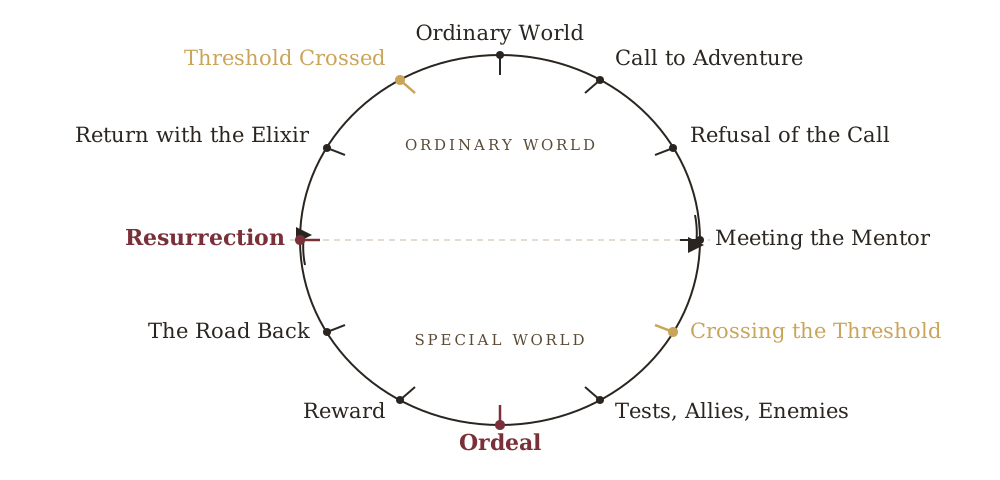
Most structural frameworks describe what happens in a story. The hero’s journey describes what happens to the person at its centre. That distinction matters more than any specific stage or threshold, and it is the reason writers keep returning to Campbell’s model fifty years after The Hero with a Thousand Faces even when they have no intention of writing myth.
The appeal is not the twelve steps. The appeal is the underlying claim: that a story about someone who leaves the familiar, is changed by the unfamiliar, and returns bearing the cost and the gift of that change has a shape the reader recognises before they can name it. Whether that recognition is hardwired or culturally trained is an argument for anthropologists. For the working novelist, the question is simpler: does this framework help you build a transformation arc that holds across three hundred pages?
Sometimes it does. Sometimes it produces a paint-by-numbers fantasy with a reluctant hero, a wise mentor, and an underworld that exists only to test courage. The difference is whether you use the journey as a lens for your story or as a template you fill in.
The actual shape
Campbell’s monomyth describes three movements — separation, initiation, return — and a set of stages within each. Later adapters, particularly Christopher Vogler in The Writer’s Journey, compressed and relabelled these for screenwriters. The stages most writers encounter are Vogler’s twelve, not Campbell’s seventeen, and the distinction matters less than understanding what each movement does.
Separation. The hero exists in an ordinary world. Something disrupts it — a call to adventure. The hero resists (refusal of the call), then crosses a threshold into a world that operates by different rules. This is functionally the same work as act one in three-act structure, but with a crucial difference: three-act cares about establishing the situation; the journey cares about establishing the person. The ordinary world exists to show who the hero is before the transformation, so the reader can measure the distance travelled by the end.
Initiation. The hero faces tests, meets allies and enemies, enters the innermost cave, and survives an ordeal that would have destroyed who they were at the start. This is the engine of the framework. The ordeal is not just the hardest obstacle — it is the moment where the hero’s old self dies or is broken enough to allow something new. The reward that follows is not a prize but a proof of change.
Return. The hero crosses back into the ordinary world, changed. The return is where most adaptations of the journey go wrong, because writers treat it as a denouement when it is actually the point. The hero has to integrate what they gained in the special world with the life they left. That integration is the story’s real resolution — not the defeat of the villain, not the retrieval of the object, but the answer to whether transformation survives contact with the ordinary.
Why writers get it wrong
The most common failure mode is treating the twelve steps as a checklist. Hero gets a call. Hero refuses the call. Hero meets a mentor. Hero crosses a threshold. Every stage dutifully present, every beat where Vogler’s outline says it should be, and the result reads like a screenplay written by committee — structurally complete and dramatically dead.
The problem is compliance. The journey is a pattern observed across thousands of stories, not a blueprint for generating new ones. When Campbell identified the monomyth, he was describing what stories from wildly different cultures had in common. He was not arguing that every story should include all seventeen stages, or that the stages should appear in order, or that a story missing the “belly of the whale” is structurally deficient.
The second failure is casting the journey in literal terms when the story is not literal. Not every story has a physical threshold to cross, a literal cave to enter, or a tangible elixir to bring home. The journey works metaphorically — the “special world” can be a new social class, a moral compromise, a relationship, a state of grief. But you have to make that translation yourself. The framework will not do it for you, and if you default to the literal version you will write a fantasy quest whether you intended to or not.
Where it earns its keep
Transformation-centred novels. If the story is fundamentally about a character becoming someone different — not just solving a problem but being changed by the process of solving it — the journey provides a vocabulary for structuring that change. The ordinary world anchors who they were. The ordeal breaks who they were. The return tests whether the new version holds.
Coming-of-age fiction. The genre is almost definitionally a hero’s journey: a young person leaves the known world (childhood, home, a small town), is tested by an unfamiliar one (university, the city, a first serious relationship), and returns — literally or psychologically — changed. The framework does not make these novels formulaic because the content is specific enough to resist the template.
Literary fiction with mythic resonance. Marilynne Robinson’s Gilead is a return story — an old minister writing to his young son, trying to bring back the meaning of a life lived in the special world of faith and loss. It follows none of the twelve steps and embodies the journey’s deepest claim: that transformation demands reckoning. Toni Morrison’s Song of Solomon sends Milkman Dead on a literal and genealogical journey south, and the return transforms his understanding of identity, flight, and inheritance. Morrison was not following Campbell. She was telling a story that the monomyth happens to describe, because the pattern is real even when the template is not.
Where it does not
Plot-driven genre fiction. A thriller protagonist who solves a crime and goes home is not on a hero’s journey just because there is an ordeal. If the character is fundamentally the same person at the end — competent before, competent after, just with this particular case closed — the journey framework adds nothing. Three-act structure or the Fichtean Curve will serve better, because they organise events rather than transformation.
Ensemble stories. The journey assumes a single hero. It can be stretched to accommodate a deuteragonist, but five point-of-view characters each on their own journey will produce a structural mess. The stages collide, the thresholds multiply, and the reader loses the through-line that makes the pattern legible.
Anti-transformation stories. Some of the best novels are about characters who fail to transform, or who transform and it does not matter, or who resist the journey entirely. The framework has no vocabulary for this because it assumes transformation is the destination. A novel like A Confederacy of Dunces — where the protagonist survives every crisis without learning a thing — is structurally invisible to the monomyth.
Stories with no return. Tragedy, in the classical sense, does not complete the circle. The hero crosses the threshold, faces the ordeal, and is destroyed. There is no return, no integration, no elixir brought home. You can force-fit tragedy into the journey by calling the destruction a “resurrection” of understanding, but that is the framework bending the story rather than describing it.
Using it without being used by it
The productive way to work with the hero’s journey is as a diagnostic, not a generative tool.
Write your story — outline it, draft it, whatever your process is. Then lay the journey over it and ask what it reveals. Is there an ordinary world that the reader understands well enough to measure the protagonist’s change against? Is there an ordeal that actually breaks something in the protagonist, or just an obstacle they overcome through effort? Does the ending address what the journey cost, or does it just resolve the plot?
These are useful questions regardless of whether your story maps to the twelve steps. You do not need a mentor character or a literal threshold crossing. You need a protagonist who is changed by the events of the story, and a structure that makes the reader feel the distance between who they were and who they became.
If the diagnostic reveals that your protagonist is not really transformed — that they enter the story competent and leave it competent, just with a different problem solved — then either the hero’s journey is the wrong lens for this story, or the story needs deeper character work. Both are valid conclusions. The framework is a mirror, not an instruction manual.
The mentor problem
Every writing guide that covers the hero’s journey spends time on the mentor, and it is worth addressing because the mentor is where most derivative fiction starts.
The mentor exists in Campbell’s framework to represent the threshold between the ordinary and special worlds — a figure who has already made the journey and can give the hero the tools or knowledge to survive the crossing. In practice, this produces Gandalf, Obi-Wan, Dumbledore, and a thousand lesser imitations. The wise old figure who delivers exposition, provides a weapon, and dies at a structurally convenient moment.
The problem is not the archetype. It is the literalism. A mentor does not have to be a person. It can be a book, a memory, a failure that teaches what no teacher could. In The Road by Cormac McCarthy, the father is both hero and mentor — he carries the knowledge of the old world across the threshold of apocalypse, and his death is the son’s ordeal. The “meeting with the mentor” happened before the novel started. The entire book is the threshold crossing.
If you find yourself writing a wise older character whose primary function is to explain the world to the protagonist, stop and ask whether that information could arrive through crisis instead. It almost always can, and the story will be stronger for it.
The journey and revision
The hero’s journey is most valuable in revision. A first draft reveals the story you actually wrote, which is often different from the story you planned, and the monomyth gives you a framework for asking whether the transformation arc is complete.
Map the protagonist’s internal state at the beginning, the midpoint, and the end. If the beginning and end are different, trace where the change happened. Was it earned — did the story force the change through pressure the protagonist could not avoid? Or was it declared — did the protagonist simply decide to be different because the plot required it?
The ordeal is the hinge. In a working transformation arc, there is a moment where the protagonist’s old approach fails catastrophically enough that they cannot go back to it. If that moment is missing, the transformation will feel unearned no matter how well the prose sells it. If that moment exists but is buried in a subplot or underplayed in a single paragraph, revision means pulling it to the surface and giving it the structural weight it needs.
The return is the proof. Does the ending show the transformed protagonist in a context where the reader can measure the change? Not told — shown. Not in internal monologue — in a choice, an action, a way of being in the world that was not available to the person who started the story. If the ending resolves the plot but does not address the transformation, the journey is incomplete.
Last updated April 26, 2026.