— Story structure —
The Fichtean Curve
Begin in crisis. Stay in crisis. Resolve.
A narrative structure that skips the slow build and drops the reader straight into rising action. How it works, when to use it, and how to plan a novel around escalating crises.
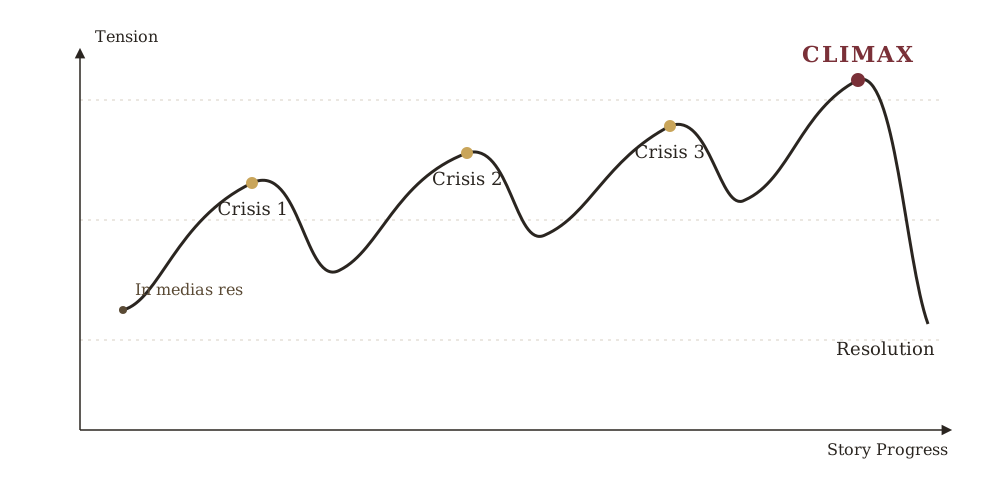
Every other narrative structure gives you permission to warm up. Three-act wants a full first act of establishment. The hero’s journey opens in the ordinary world. Even the five-act model lets you ease in.
The Fichtean Curve starts with the building already on fire.
The name comes from Johann Gottlieb Fichte, the German philosopher, though the connection is loose — his dialectical method (thesis, antithesis, synthesis) moved fast and resolved through conflict, and the narrative structure borrows that restlessness. What matters for the working writer is simpler: the story opens in the rising action and never leaves it. Your protagonist is already in trouble on page one. The trouble gets worse. It keeps getting worse through a series of distinct crises until a climax forces the issue, and then the book ends.
Three moving parts
Where three-act structure looks like a mountain, the Fichtean Curve looks like a staircase that runs into a wall.
Rising action. You open here. No setup tour, no “meet the characters” chapter. The protagonist has a problem, and solving that problem creates a worse one, which creates a worse one still. The reader figures out who these people are by watching them under pressure.
Climax. The crises converge. The protagonist hits the problem they have been stumbling toward through every smaller disaster, and this time the partial fix will not work.
Falling action. Short. Sometimes brutally short. One chapter. A few pages. The threads close, the consequences land, done.
What makes the structure distinctive is not the shape but what does the work: crisis is the unit of story. A crisis advances the plot (something happens) and develops the character (their response to it tells us who they are) at the same time. You do not need a separate character-establishment phase. The crises handle it.
The real difference from three-act
Three-act assumes the audience needs to see normal before they can feel the disruption of normal. The Fichtean Curve bets that you can build “normal” inside the disruption — that a reader will piece together the world and the character from how the character handles trouble, without needing the quiet breakfast scene first.
That bet changes the outline. There is no planning beat called “establish the world.” Every piece of context the reader needs gets smuggled in through a crisis, delivered at the moment it becomes dramatically necessary and not a page earlier.
Where it fits
Episodic literary fiction. Novels built from a sequence of contained disasters — social humiliations, workplace collisions, relationship implosions — that pile up rather than building a single long arc. Kingsley Amis did this. John Kennedy Toole’s A Confederacy of Dunces is the textbook case. Early Philip Roth.
Detective fiction. A case opens (crisis one), a lead fails (crisis two), a complication surfaces (crisis three), and so on. The investigation is a series of crises, and how the detective handles each one is what makes them interesting.
Character studies under pressure. If what you care about is how someone responds to trouble, not the mechanics of the trouble itself, this structure puts that question on display from line one.
Delayed-context stories. Because the structure withholds backstory, it creates a natural drip-feed. The reader assembles who this person is and how they got here while the crises unfold. Gillian Flynn does this in Gone Girl. Donna Tartt does it in The Secret History — the murder is on page one, and the entire novel is the staircase that led there.
Where it doesn’t
World-heavy genres. If the reader needs fifty pages of rules before a crisis makes sense — epic fantasy, hard science fiction — dropping them into trouble first will confuse, not engage.
Ensemble casts. The Fichtean Curve is built for a single protagonist’s escalation. It does not accommodate six point-of-view characters with interlocking storylines particularly well.
Slow-burn tension. If your novel runs on a single pressure that builds across years — a marriage eroding, a family secret surfacing — the discrete-crisis staircase will feel forced. That kind of story needs a ramp, not steps.
Outlining for the Fichtean Curve
The planning method is different from what you are used to if you normally outline in acts.
Work backward from the climax. What is the worst possible convergence of problems for this protagonist? That is your ending. Now chain the crises that lead there, each one causally connected to the next. Not random bad luck — a sequence where solving crisis two creates the conditions for crisis three.
The exposition — everything three-act structure would have put in act one — gets parceled out across these crises. A crisis in chapter four is the place to reveal the backstory detail that makes the crisis in chapter seven land. The discipline is restraint: no context until the moment a crisis needs it.
The staircase in practice: A Confederacy of Dunces
Ignatius J. Reilly is already in crisis when the novel opens. His mother has driven into a building and they owe money they do not have. From there it only gets worse.
He is forced to find a job — his self-image as a medieval philosopher meets the job market. He takes a position at a pants factory and immediately begins organizing the workers into a protest, which gets him fired. He becomes a hot dog vendor and eats most of the inventory. He tries to launch a political party. His mother, finally, arranges to have him committed.
Every disaster is worse and funnier than the last, and every one of them shows you something new about Ignatius — his intelligence, his self-deception, the real fragility under all that bluster. The climax is a catastrophic public speech where every thread collides. The falling action is one chapter: Ignatius escapes to New York with Myrna Minkoff, having learned absolutely nothing.
Toole never needed a setup act. The reader knows Ignatius by page thirty because the crises did the job.
The revision test
Whether you planned a Fichtean structure from the outline or stumbled into one during revision, the question to ask is the same: is every crisis earning its place?
A crisis that moves the plot but tells you nothing new about the character is a set piece — exciting, maybe, but structurally hollow. A crisis that deepens the character but stalls the plot is a vignette. The Fichtean Curve cannot carry passengers.
Answering that question honestly means stepping back from the prose and looking at the manuscript as a structure — pacing across chapters, the arc of escalation from first crisis to last, whether the crises genuinely build or just accumulate. It is developmental editing work, the kind of reading that looks at architecture rather than sentences.
Last updated April 22, 2026.